
A Cultural Week in Armenia
Armenia's great monuments, museums and towns in one week, at an easy pace and in any season.
- 7 days
- Easy
- All year
Price on request
View tour
A UNESCO monastery partly carved into the cliff, in a gorge above the Azat river.
Written by Wild Armenia guides · Last verified 2026-11-03
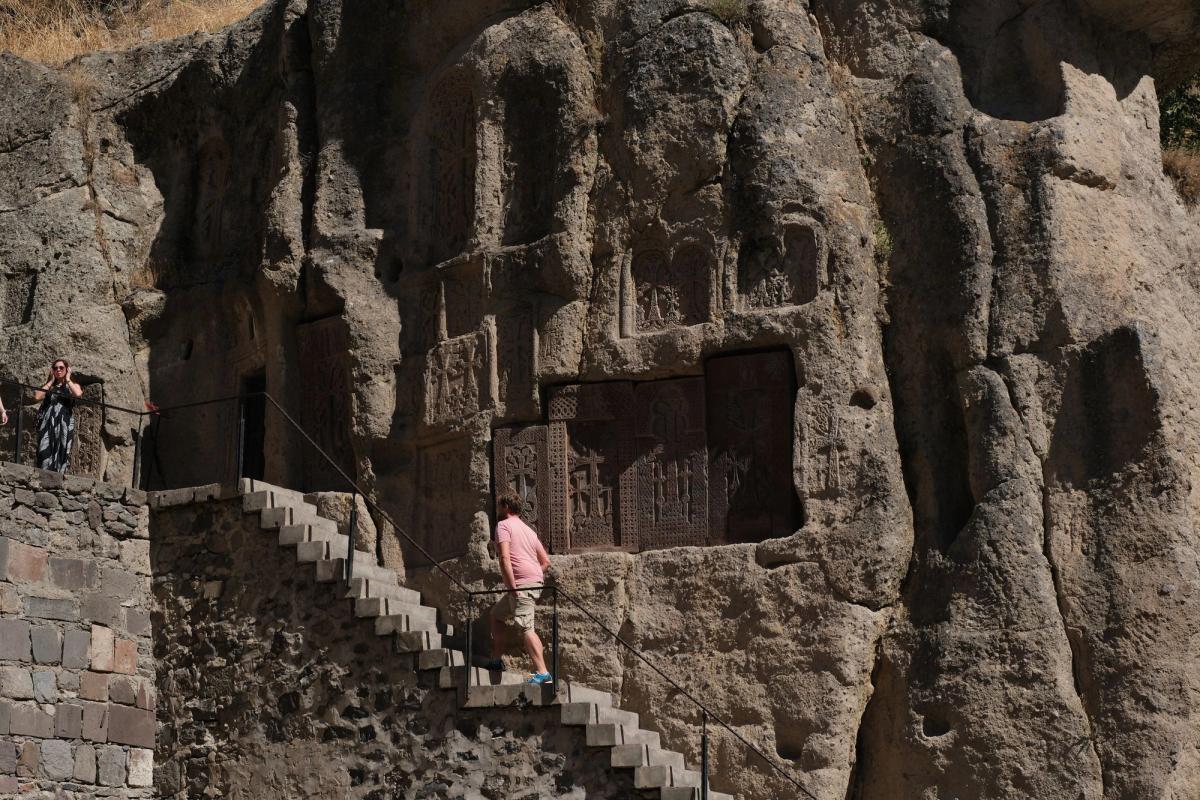
Geghard looks as if the cliff had grown a monastery. Its main church stands in a walled yard, but behind it chapels, tombs and halls are cut straight into the rock, lit by a single opening in the ceiling. Water drips from the stone, and the singing in the rock chambers rings in a way few places do.
The monastery is part of the UNESCO World Heritage site Monastery of Geghard and the Upper Azat Valley. It lies a few minutes beyond Garni, so most visitors see the two together.
Armenia's great monuments, museums and towns in one week, at an easy pace and in any season.
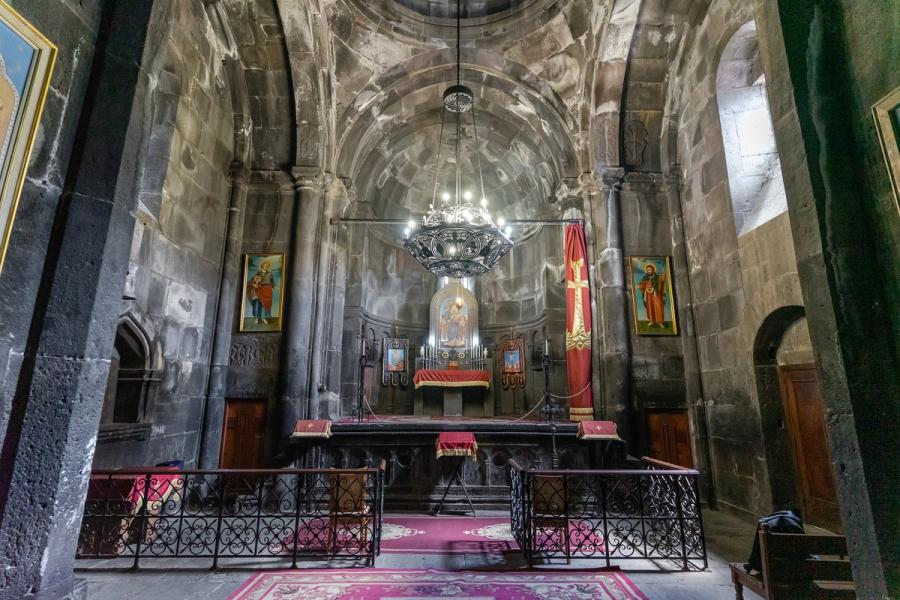
The main church was built in 1215 under the Zakarid princes Ivane and Zakare. It is a cross-in-square building with a dome, covered in carved crosses and details. A porch, or gavit, was added later, and its north wall is the natural rock itself.
Through openings in the gavit's rock wall you enter chapels hewn from the mountain. Each has carved crosses, columns and domes cut straight from stone, with light falling through a round opening above. A second, still deeper level holds family tombs of the princes.
In the 13th century Prince Prosh Khaghbakyan commissioned an underground church called the Avazan, or Vimapor. A spring rises inside one of the rock chambers and is considered holy. Visitors often drink from it and listen to the echo in the stone.
Dozens of carved cross-stones, or khachkars, stand along the walls and cliff, and small cells and caves are cut into the slope above. A short walk up the path gives a view down into the gorge and the monastery from above.
Photos: Anton Skrobotov, CC BY-SA 2.0
A monastery stood here early in the Middle Ages, and tradition says a sacred spring drew pilgrims even before Christianity. Its name, Geghardavank, means Monastery of the Lance, because tradition holds that the spear that pierced Christ's side was kept here for centuries. Most of what you see dates from the 13th century, when the Zakarid princes and the Proshian family built the main church and carved the rock chambers. The complex is on the UNESCO World Heritage list.
| When | What happened |
|---|---|
| Early Middle Ages | A monastery stands by the sacred spring |
| 1215 | Katoghike church is built |
| 13th c. | The rock-cut churches and the Avazan are carved |
| 2000 | The monastery and the Upper Azat Valley join the UNESCO list |
Geghard sits in a narrow gorge at about 1,800 m, with cliffs rising on both sides and the Azat river below. Juniper and wild herbs grow on the slopes, and birds of prey often circle above the monastery.
Green slopes, flowing streams and few visitors.
Good for quiet visits
Cool inside the rock, warm outside; mornings are best.
Best early in the day
Golden slopes and clear light.
Best for photography
Snow on the cliffs; the monastery stays open.
For snowy views
Everything is within a short walk of the car park, up a gentle path and a few steps.
Stay in Yerevan or in a guesthouse in Garni for an early start before the groups arrive.
Stalls by the car park sell fruit lavash, dried fruit and sweets. For a full lunch, go back to the family kitchens in Garni.
Start at Geghard in the quiet morning, then drive back to Garni for the temple, the gorge and lunch.
Add Geghard to a week-long route through Armenian monasteries and cities.
About 40 km, roughly an hour by car.
Tradition says the spear that pierced Christ was kept here for centuries.
Yes, with the Upper Azat Valley, since 2000.
Allow 1.5 to 2 hours.
The monastery is free to enter. Check whether parking is charged on the day.
Get seasonal tips, new routes and ideas for your next trip to Armenia.
Thank you. We will be in touch soon.

